By Esinam Asima
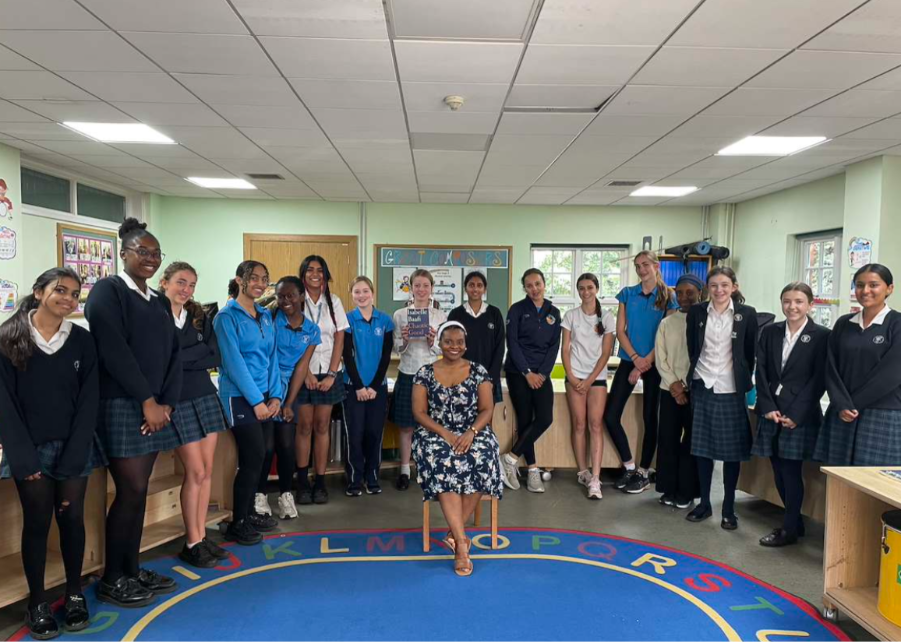
On Tuesday the 16th of June poet, award-winning poet Isabelle Baafi visited St Augustine’s and directed a poetry workshop hosted by the English Department.
A select group of pupils were invited to take part in an afternoon of close-reading, literary exploration and reflective writing guided by one of the most inspiring contemporary voices in British poetry.
Baafi, whose debut collection ‘Chaotic Good’ (Faber & Faber) has already earned significant acclaim, including the Forward Jerwood Prize for Best First Collection in 2025 and nomination for the T.S. Elliot Prize. She has also won the 2023 Winchester Poetry Prize, the Second Prize of the 2022 London Magazine Poetry, as well as the 2019 Vincent Cooper Literary Prize. Her visit allowed students a rare opportunity to engage directly with a writer at the forefront of modern poetry.
The workshop opened with an unusual prompt as we wrote a list of animals or creatures that fill us with disgust or hatred. Spiders were at the top of the list for many. But the poem we later looked at, ‘Mama Cockroach, I Love You…’ by Fiona Benson was about a cockroach, and the poem actually humanised her by outlining the similarities of motherhood shared between species. This showed how poetry can humanise even the most unlikely subjects.
Mama Cockroach, I Love You

by Fiona Benson


Blattodea

Because you cosy with the aunties in your
reeking slums, and are intimate and sweet.

Because you begrudge no one a meal, but ooze
a faecal trail to lead your commune to its source,

like a dirty bee. Because you are joyfully promiscuous.
Because you pouch your young and hide them

in the sweaty creases of the house
near suppurating food so they’ll hatch to a feast;

or, keep your eggs with you in a special purse
shaped like a kidney bean, and clutch it fast;

or reinsert them into your abdomen
and womb them there; or carry them as yolks

and give live birth, then feed your pale brood
secretions from your anus, or your armpit glands,

like milk; or, deep in the flesh of a rotten log
pass them a bolus of pre-digested food, mouth to mouth.

Because you suffer your young to swarm upon
your back, and do not flinch or buck them off,

but carry them like a human playing horsey
with her children, down on hands and knees,

decrying the swag of her own loose flesh.
Because you twirl your antennae gracefully

to test your crawl space. Because strokingly
you caress your offsprings’ backs, and gentle them

with pretty pheromones and chirps. Because
you purr when your young stroke your face.

Because you would leave your body for your offspring
to dine upon — all the liquors and gravy

of the obscene world, your work in the crannies
delivered to the living. Because you are,

despite all rumours, mortal. And what if
you are crushed before your eggs can be delivered?

What if your sisters drive you, hissing, out?
What if your kitchen is fumigated?!

What if the mongoose the lizard the snake —
a muscular tongue prying at the warm and greasy interstices

of your stubborn occupancy — takes you in its mouth?
Someone must care for the dirt.
The second prompt focused on finding beauty in uneasy processes of change or transformation. Led by Baafi, we analysed Katrina Naomi’s ‘My Sister and the Heavy Magic’ which describes her sister’s ‘heavy’ battle with cancer and the emotional complexities of battling an illness.
Next, we had a look at ‘Earth Presses Us’ written by the renowned Palestinian poet Mahmoud Darwish. The powerful piece allowed us all to meditate on themes of confinement, displacement and resilience prompting thoughtful conversation on the human cost of conflict.
Earth Presses Against Us

By Mahmoud Darwish

Earth is pressing against us, trapping us in the final passage.
To pass through, we pull off our limbs.
Earth is squeezing us. If only we were its wheat, we might die and yet live.
If only it were our mother so that she might temper us with mercy.
If only we were pictures of rocks held in our dreams like mirrors.
We glimpse faces in their final battle for the soul, of those who will be killed
by the last living among us. We mourn their children's feast.
We saw the faces of those who would throw our children out of the windows.
of this last space. A star to burnish our mirrors.
Where should we go after the last border? Where should birds fly after the last sky?
Where should plants sleep after the last breath of air?
We write our names with crimson mist!
We end the hymn with our flesh.
Here we will die. Here, in the final passage.
Here or there, our blood will plant olive trees.
To conclude the session, Baafi read from her collection ‘Chaotic Good’ including the poem ‘Exit Interviews. The piece reflects on leaving, self-discovery and the tug and pull between feelings of duty and desire which resonated strongly with the group.
Exit Interview

By Isabelle Baafi

I've started ending phone calls like on TV—
quick and heartless. The goodbye is implied.
A need becomes a needle if we let it.

My mother always said,
If you reach a fork in the road, go right.

But what if the right path is not the right path?

The way out is steeper than the way in.
But when a road reveals itself out of nowhere, I take it.
I take the coarse road and I don't look back.
In truth, I leave the way my father left:
piece by piece. My favourite books
and sharpest cutlery in the room across town

that I told myself I had rented ‘for my writing’;
my wedding ring gathering dust on a shelf
next to the watch I kept trying to give away.

And the apps I hid from view, the friends
never introduced him to. The dream in which I shut
corridor of doors, one by one. Peace by peace.

I choose right. I choose what's right.
I choose left. I choose what's left. I am the one
who soils my sheets and the one who cleans them.